
In my journey of becoming a mathematics educator, one lesson I’ve learned over and over, is that your perspective matters. In this series of sketchnotes I share how my perspective on what counts as meaningful mathematics learning and teaching has shifted over time.
Initially, I viewed meaningful mathematics learning and teaching from the perspective that multiple representations support meaningful math learning. (See also Meaningfulness in representational fluency by Fonger, 2019)
Later I learned to expand this lens on meaningful mathematics learning to include instructional tasks that are rooted in realizable situations, such as a growing square. Such learning contexts support quantitative reasoning and meaningful math learning. (See also A Quadratic Growth Learning Trajectory by Fonger, Ellis, Dogan, 2020).
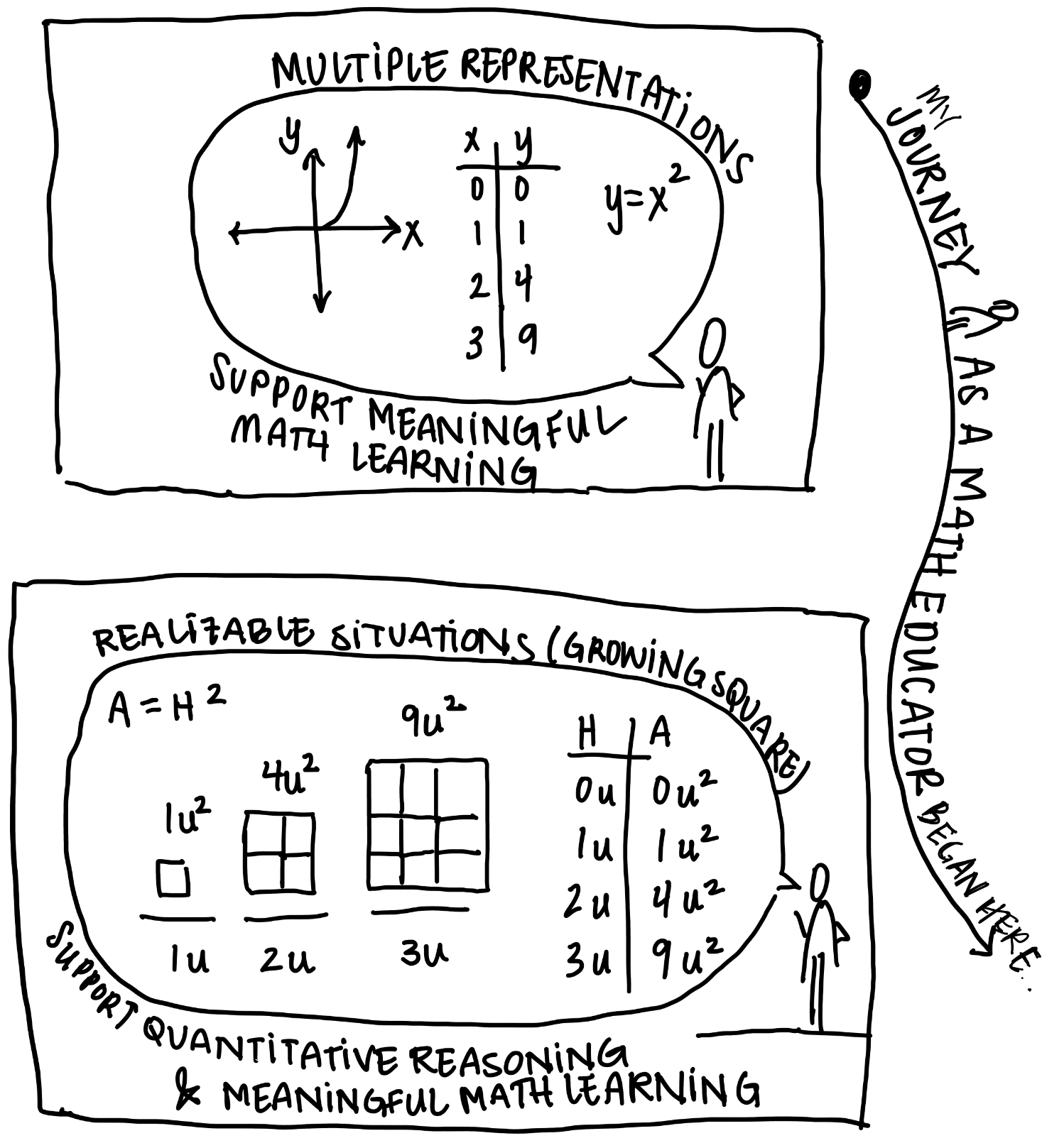
From over a decade of partnering with teachers to co-create learning environments that support all learners, my journey to support meaningful math learning demanded new perspectives. I have learned that I need to both zoom in on students’ reasoning with and about multiple quantitative representations, and to zoom out to center the people, places, and futures of our students. (See also People, place, and population predictions by Keech, Routhouska, and Fonger, 2022).

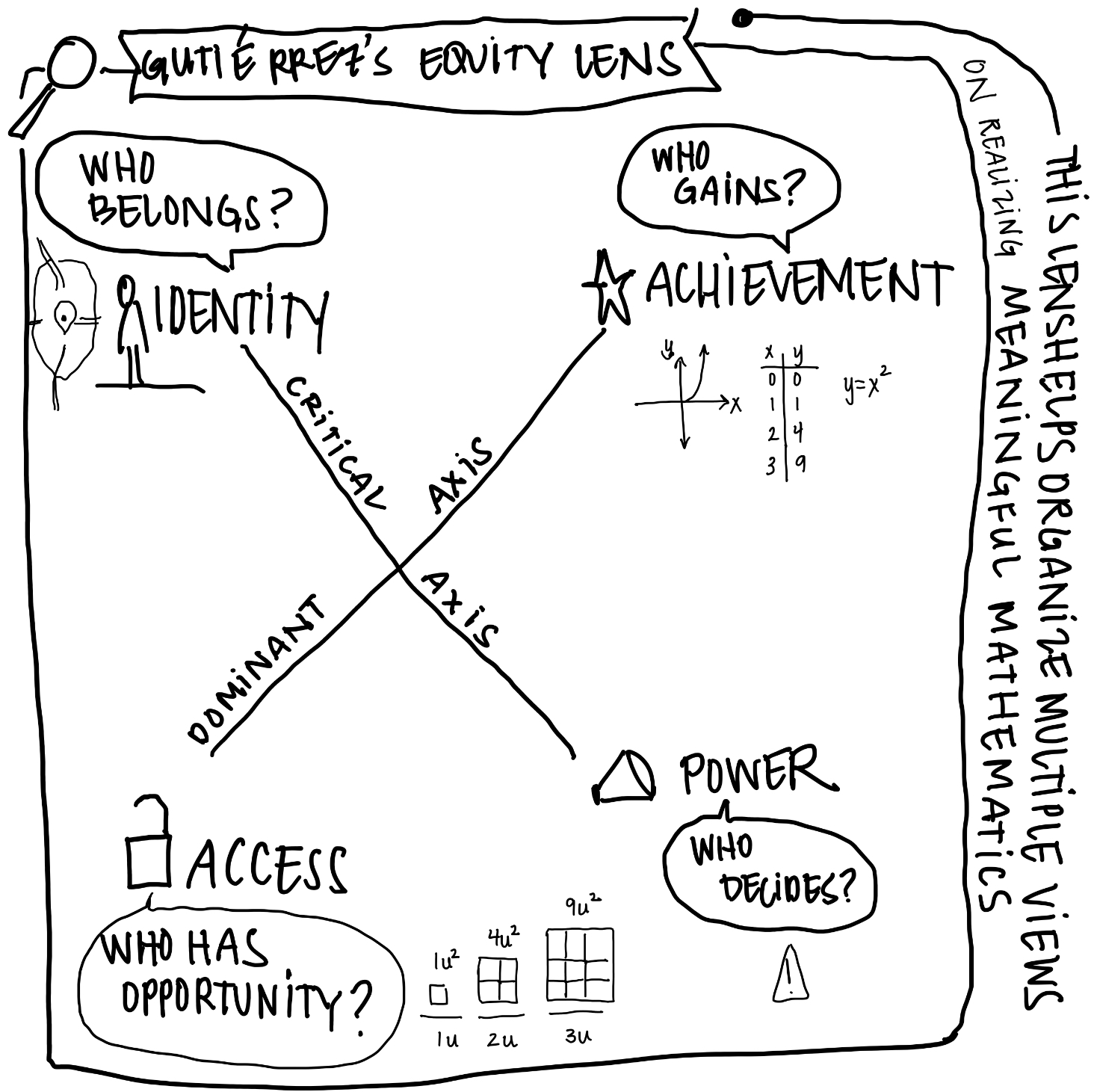
Part of what has supported me to see from multiple lenses or perspectives is Rochelle Guitérrez’s (2009) equity lens. Gutiérrez’s equity lens has helped me navigate my journey as a mathematics educator, and accept shifting of perspectives as a necessary practice of teaching all learners to experience mathematics as meaningful. (See also Making Algebra Meaningful: A Visual Approach to Math Literacy for All by Fonger, 2024).
Additional Resources and References
Fonger, N. L. (2024). Making Algebra Meaningful: A Visual Approach to Math Literacy for All. Teachers College Press, Teachers College, Columbia University. ISBN 9780807769966
Fonger, N. L. (2019). Meaningfulness in representational fluency: An analytic framework for students’ creations, interpretations, and connections. Journal of Mathematical Behavior, 54 https://doi.org/10.1016/j.jmathb.2018.10.003
Fonger, N. L., Ellis, A., Dogan, M. F. (2020). A quadratic growth learning trajectory. Journal of Mathematical Behavior, 59, 1-22. https://doi.org/10.1016/j.jmathb.2020.100795
Gutiérrez, R. (2009). “Framing equity: Helping students ‘play the game’ and ‘change the game.’” Teaching for Excellence and Equity in Mathematics, 1(1), 5–7.
Keech, K., Routhouska, B., Fonger, N. L. (2022). People, place, and population predictions. Mathematics Teacher: Learning and Teaching PK-12. 118(8), 566-575. https://doi.org/10.5951/MTLT.2021.0120
 Nicole L. Fonger
Leave a comment